When people hear the word depression, they often imagine someone who feels persistently sad, hopeless, or emotionally overwhelmed.
But depression doesn't always announce itself through obvious emotional symptoms.
For some people, the first clues are physical.
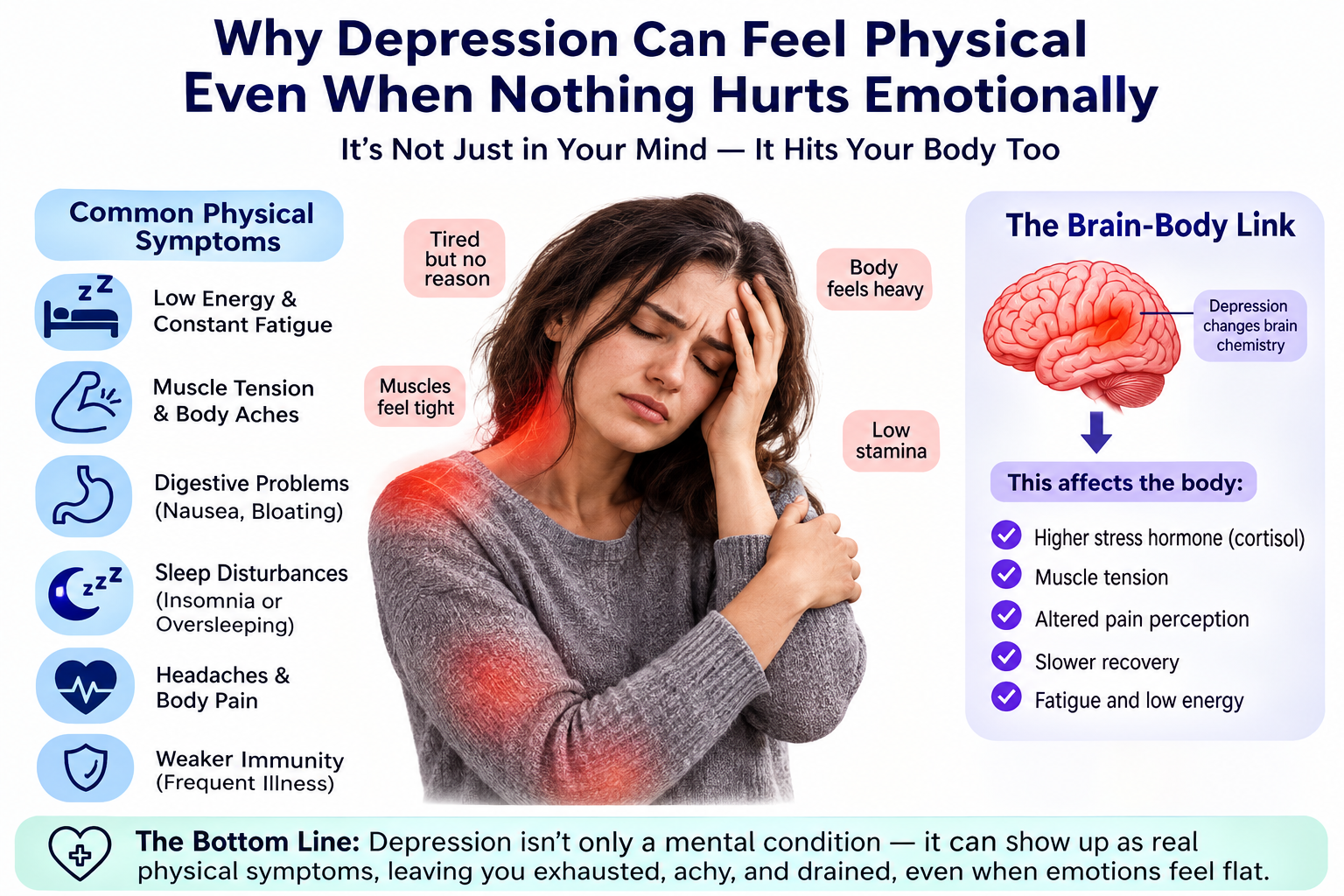
They may wake up exhausted despite sleeping for hours. Their body may feel heavy. Their appetite may change. They may experience headaches, digestive problems, unexplained aches, or a general feeling that something isn't right.
Sometimes a person may even say:
“I don't feel particularly sad. I just don't feel physically well.”
That experience can be confusing, particularly when medical tests don't immediately reveal an obvious physical cause.
Depression can involve changes in mood, thinking, behavior, sleep, appetite, energy, and physical functioning. The National Institute of Mental Health (NIMH) describes symptoms including fatigue, changes in sleep or appetite, difficulty concentrating, and physical complaints such as aches or digestive problems. NIMH: Depression
How Can Depression Affect the Body?
Your brain and body aren't separate systems.
Mood, sleep, appetite, energy, hormones, nervous-system activity, and pain perception are interconnected.
When depression affects brain function and daily behavior, those changes can influence the rest of the body.
For example, someone experiencing depression may:
Sleep considerably more or less than usual
Eat much more or less than usual
Move less during the day
Experience persistent fatigue
Have difficulty concentrating
Become less physically active
Notice increased sensitivity to discomfort
Develop headaches or digestive complaints
This doesn't mean that every unexplained physical symptom is caused by depression.
That's an important distinction.
Physical symptoms can have many possible causes, so persistent or unusual symptoms should be evaluated by a healthcare professional rather than automatically attributed to mental health.
1. Fatigue Can Be One of the Biggest Clues
One of the most common physical experiences associated with depression is persistent tiredness.
But depression-related fatigue can feel different from simply having a busy day.
A person might sleep for an adequate amount of time and still wake up feeling exhausted.
Even simple activities can feel difficult.
Getting dressed, preparing food, answering messages, or completing household tasks may require much more effort than usual.
The problem isn't necessarily a lack of physical strength. Instead, the person may experience a profound reduction in energy and motivation.
NIMH lists fatigue or decreased energy among common symptoms of depression. NIMH: Depression Symptoms
2. Depression Can Change Your Sleep
Sleep and depression have a complicated relationship.
Some people with depression sleep much more than usual.
Others develop insomnia or wake repeatedly during the night.
Some may fall asleep easily but wake very early and struggle to return to sleep.
Poor sleep can then contribute to daytime fatigue, concentration problems, irritability, and reduced motivation.
This can create a difficult cycle:
Depression → disrupted sleep → fatigue → reduced activity → worsening mood
And the cycle can work in the opposite direction as well:
Poor sleep → emotional vulnerability → increased stress → worsening mood
That's why sleep patterns are often an important part of evaluating depression.
The National Institute of Mental Health discusses changes in sleep as one of the potential symptoms of depression. NIMH: Depression Overview
3. Your Appetite May Change
Depression can also affect eating patterns.
One person might lose interest in food.
Another might use food as a source of comfort and eat more frequently.
These changes can occur alongside alterations in weight and energy levels.
Importantly, appetite changes aren't proof of depression by themselves.
They can also occur with gastrointestinal conditions, hormonal changes, medications, sleep problems, and numerous other medical conditions.
That's why clinicians consider the overall pattern of symptoms rather than relying on a single sign.
4. Depression Can Make the Body Feel Heavy
A particularly interesting experience is the feeling of physical heaviness.
Someone may describe their arms and legs as feeling unusually heavy or say that ordinary movement requires considerable effort.
This can be accompanied by:
Slower movement
Reduced activity
Low energy
Difficulty getting started
Spending more time in bed or sitting
A general sense of physical exhaustion
This experience can be especially frustrating because the person may not understand why their body feels so different.
It isn't simply “being lazy.”
Depression can affect motivation, energy, movement, sleep, and concentration simultaneously.
5. Headaches and Other Physical Discomfort
Depression can occur alongside physical complaints such as headaches, digestive symptoms, or generalized aches.
At the same time, physical discomfort itself can contribute to low mood.
This creates a two-way relationship:
Emotional distress can influence how the body feels, while persistent physical symptoms can influence emotional well-being.
For someone experiencing ongoing pain, this interaction can become particularly difficult.
The presence of physical symptoms doesn't mean the symptoms are imaginary.
The discomfort can be very real even when emotional factors are contributing to it.
6. Why Can Depression Affect Pain Perception?
The brain plays an important role in how the body processes pain.
Pain isn't simply a signal traveling from a body part to the brain. The nervous system also interprets and modulates that signal.
Depression can influence this process.
As a result, some people with depression may experience physical discomfort more intensely or become more focused on uncomfortable sensations.
This doesn't mean that pain is “all in your head.”
It means that pain is a complex biological experience involving the nervous system, brain, emotions, attention, and physical health.
The National Institute of Mental Health includes physical symptoms such as aches and digestive problems among possible symptoms of depression. NIMH: Depression
7. Digestive Problems Can Appear Too
The brain and digestive system communicate continuously through the gut-brain connection.
During periods of psychological stress or emotional difficulty, some people experience changes in digestion.
Depression may occur alongside:
Changes in appetite
Constipation
Diarrhea
Stomach discomfort
Nausea
Changes in eating habits
However, digestive symptoms should not automatically be attributed to depression.
Persistent digestive problems deserve medical evaluation because gastrointestinal conditions can have many different causes.
8. Concentration Problems Can Feel Physical
Depression doesn't only affect mood.
It can also affect cognitive functioning.
A person might find themselves:
Forgetting appointments
Losing track of conversations
Reading the same paragraph repeatedly
Struggling to make simple decisions
Having difficulty organizing tasks
Feeling mentally exhausted
This can become physically draining.
After spending hours trying to concentrate, a person may feel completely exhausted even if they haven't performed strenuous physical work.
NIMH identifies difficulty concentrating, remembering, or making decisions among possible symptoms of depression. NIMH: Depression
Depression Can Look Different From Person to Person
There isn't one universal physical presentation of depression.
One person might primarily experience:
fatigue + excessive sleep + increased appetite
while another might experience:
insomnia + reduced appetite + headaches + difficulty concentrating.
Someone else might primarily notice:
body aches + low energy + loss of interest.
That's why diagnosing depression requires looking at the complete clinical picture.
Could Medication Contribute to Physical Symptoms?
Medication can also complicate the picture.
Some medicines used to treat depression can produce side effects, particularly when treatment is first started or when the dose changes.
Depending on the medication, possible effects can include changes in:
Sleep
Appetite
Energy
Digestion
Headaches
Alertness
This doesn't mean someone should stop taking an antidepressant because of a side effect.
Instead, changes should be discussed with the prescribing clinician.
The FDA provides medication information and safety communications for antidepressants and other prescription medicines. FDA Drug Safety Communications
What About Antidepressants?
Antidepressants are one treatment option for depression.
Different antidepressants work through different mechanisms, and people can respond differently to the same medicine.
Some people notice improvements in sleep, appetite, energy, or concentration before they notice a major change in mood.
Others may experience side effects before therapeutic benefits become apparent.
For that reason, clinicians generally evaluate treatment over time rather than judging a medication solely by how someone feels after one or two doses.
NIMH provides an overview of depression treatment, including psychotherapy and medication. NIMH: Depression Treatment
Therapy Can Help With Physical and Emotional Symptoms
Medication isn't the only treatment approach.
Psychotherapy can help people understand patterns of thinking, behavior, stress, and emotional responses that may contribute to depression.
Cognitive behavioral therapy (CBT) is one commonly used approach.
Therapy may also help someone rebuild routines around:
Sleep
Physical activity
Social connection
Eating patterns
Stress management
Daily responsibilities
For some people, psychotherapy and medication are used together.
The appropriate treatment depends on the person's symptoms, history, preferences, and clinical circumstances.
Don't Assume Every Physical Symptom Is Depression
This is perhaps the most important point.
If someone experiences persistent fatigue, unexplained pain, dizziness, weight changes, digestive symptoms, sleep problems, or other physical changes, depression is only one possible explanation.
Other possibilities can include:
That's why a healthcare professional may ask about both physical and emotional symptoms.
A proper evaluation can help determine whether symptoms are related to depression, another medical condition, medication effects, or several factors at once.
When Should You Seek Professional Help?
Consider speaking with a healthcare professional if physical or emotional symptoms:
Persist for several weeks
Interfere with work or school
Affect relationships
Change your sleep substantially
Change your appetite or weight
Make everyday activities difficult
Cause persistent physical discomfort
Are accompanied by significant changes in mood or behavior
If depression includes thoughts of suicide or self-harm, seek urgent professional help or emergency care rather than trying to manage the situation alone.
Final Thoughts
Depression doesn't always feel like sadness.
Sometimes it feels like exhaustion.
Sometimes it feels like sleeping too much.
Sometimes it feels like headaches, digestive problems, body heaviness, poor concentration, or unexplained physical discomfort.
These experiences are not necessarily imaginary or “just emotional.” The brain and body constantly communicate, and changes in one can influence the other.
At the same time, physical symptoms shouldn't automatically be blamed on depression. A healthcare professional can help determine what's happening and whether treatment for depression, another medical condition, or both may be appropriate.
The most important step is to pay attention when your body and mind begin behaving differently—and to seek appropriate professional evaluation rather than dismissing the symptoms.