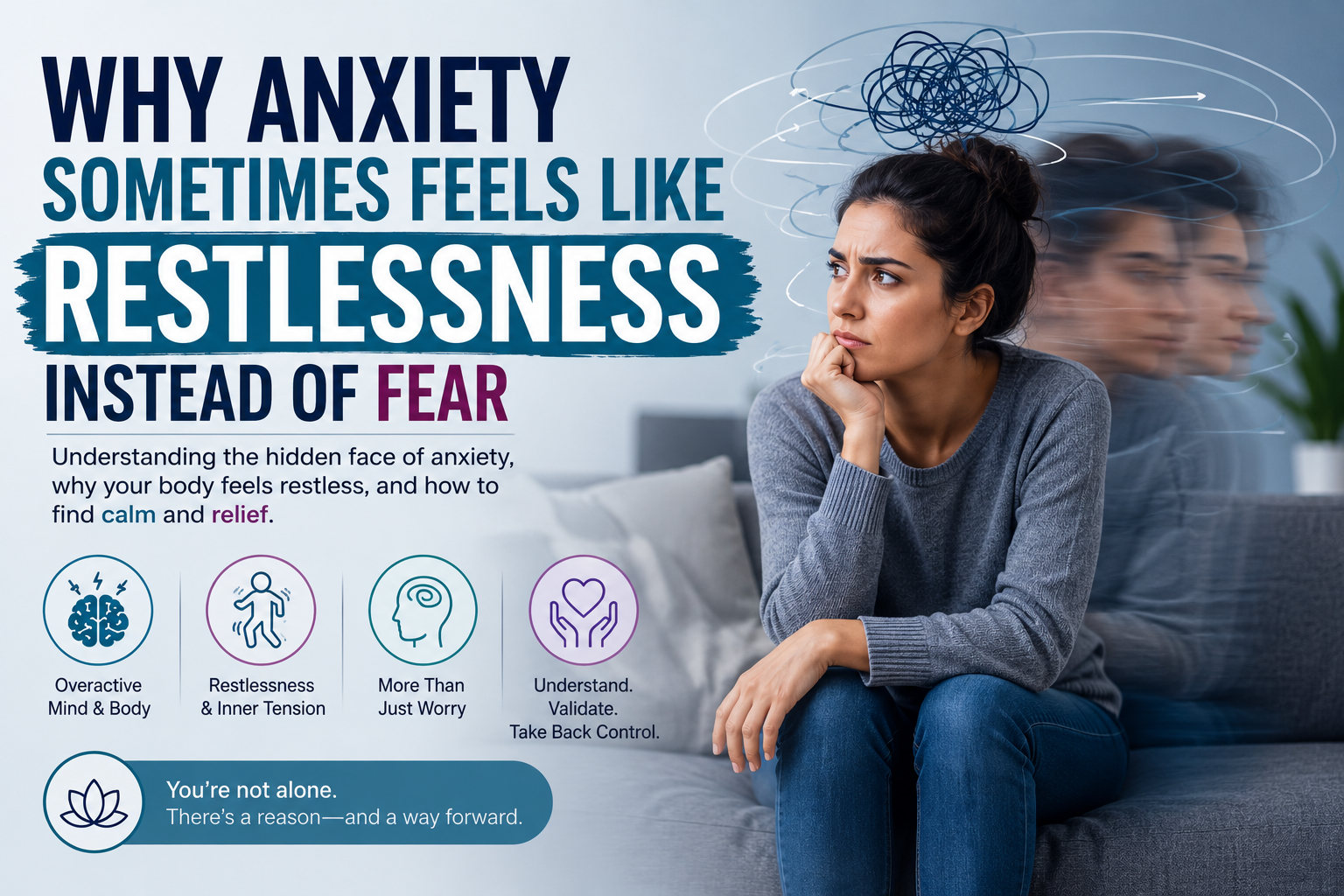
When most people hear the word anxiety, they imagine obvious fear: a racing heart, panic, worry, or a strong sense that something bad is about to happen.
But anxiety doesn't always feel like fear.
For some people, anxiety shows up as restlessness, irritability, constant movement, difficulty relaxing, muscle tension, or the feeling that they simply cannot switch off. You may feel like you need to get up, walk around, keep yourself busy, check your phone repeatedly, or constantly find something to do—even when nothing is obviously wrong.
This can make anxiety surprisingly difficult to recognize.
According to the National Institute of Mental Health (NIMH), restlessness or feeling "on edge" is one of the symptoms associated with generalized anxiety disorder (GAD), along with difficulty concentrating, fatigue, irritability, muscle tension, and sleep problems.
Anxiety Isn't Always a Feeling of Fear
Fear usually has an identifiable object.
You might be afraid of an accident, an illness, losing your job, speaking in public, or something else that feels threatening.
Anxiety can be different.
Sometimes your body enters a state of heightened alertness even when there isn't an immediate danger. NIMH explains that anxiety can occur even when there is no current threat.
That can leave you thinking:
"Why can't I relax?"
"Why do I feel like I need to keep doing something?"
"Why am I irritated by everything?"
"Why does sitting still feel uncomfortable?"
The answer may be that anxiety is expressing itself primarily through your body's state of arousal rather than through an obvious feeling of fear.
What Does Anxiety-Related Restlessness Feel Like?
Restlessness can look different from person to person.
You might:
Constantly change positions
Tap your feet or fingers
Walk around without a clear reason
Feel uncomfortable sitting still
Keep yourself constantly occupied
Have difficulty relaxing in the evening
Feel "wired" despite being tired
Become unusually impatient or irritable
Find yourself repeatedly checking messages or information
Have trouble settling down to watch a movie or read
Feel as though you need to "do something"
Some people experience this alongside physical symptoms such as muscle tension, headaches, sweating, rapid heartbeat, stomach discomfort, or difficulty sleeping. Anxiety can affect the mind, body, and behavior simultaneously.
Why Does Anxiety Create Restlessness?
One reason is the body's response to perceived stress.
When you're anxious, your body can activate its stress response. Stress hormones such as adrenaline and cortisol are involved in this response and can produce physical changes including increased heart rate, sweating, shaking, and heightened alertness.
From an evolutionary perspective, this response is useful when you actually need to respond to danger.
The problem is that anxiety can activate similar responses when the "threat" is uncertainty, worrying about the future, financial pressure, relationship problems, work stress, or even a thought that keeps repeating in your mind.
Your body may essentially be saying:
"Stay ready."
And staying ready can feel like restlessness.
The Mind-Body Connection
Anxiety isn't only happening in your thoughts.
Your thoughts can affect your body, and physical sensations can influence your thoughts in return.
For example:
Worry → muscle tension → physical discomfort → more worrying → greater tension
Or:
Uncertainty → feeling on edge → checking for reassurance → temporary relief → more checking later
Over time, these patterns can become familiar.
This is one reason anxiety may sometimes feel more physical than emotional.
You may not consciously think, "I'm afraid."
Instead, you may simply feel unable to settle down.
Why Restlessness Can Be Confused With Other Things
Anxiety-related restlessness can resemble several other experiences.
Someone may assume they're simply impatient, energetic, stressed, bored, or having trouble concentrating.
Other factors can also contribute to restlessness, including sleep deprivation, excessive caffeine, certain medications, substance use, and some physical health conditions. MedlinePlus notes that physical conditions such as thyroid problems and heart-rhythm issues can sometimes produce symptoms that overlap with anxiety.
That's why it's important not to automatically diagnose yourself based on one symptom.
If restlessness is new, persistent, severe, or accompanied by other concerning symptoms, discussing it with a healthcare professional can help determine what's behind it.
Anxiety and Muscle Tension Can Go Together
Another reason anxiety may feel like physical agitation is muscle tension.
When you're constantly on alert, you may unconsciously tighten your shoulders, neck, jaw, back, or other muscles.
NIMH lists muscle tension and restlessness among symptoms associated with generalized anxiety disorder.
You might notice that you're:
The physical discomfort can then make it even harder to relax.
Why Anxiety Can Become Worse at Night
Nighttime can make restlessness particularly noticeable.
During the day, work, conversations, errands, entertainment, and responsibilities can keep your attention occupied.
When everything becomes quiet, your thoughts may become much louder.
You finally sit down—and suddenly your brain begins reviewing tomorrow's responsibilities, replaying conversations, imagining possible problems, or worrying about things you cannot control.
That mental activity can make the body feel restless even though you're physically exhausted.
Sleep problems are also commonly associated with anxiety.
This can create another cycle:
Anxiety → restlessness → difficulty sleeping → fatigue → increased difficulty coping with stress → more anxiety
What Can Help?
The goal isn't necessarily to force yourself to "stop feeling anxious." Instead, it can be more useful to identify what's happening and gradually teach your body and mind that they don't need to remain constantly activated.
1. Notice the Pattern
Start paying attention to when the restlessness appears.
Is it worse:
Before work?
After checking the news?
During social situations?
At bedtime?
After drinking caffeine?
When you're alone with your thoughts?
During periods of uncertainty?
Identifying patterns can help you understand potential triggers.
2. Give Your Body a Healthy Outlet
Walking, stretching, exercise, or other forms of physical activity can provide a constructive outlet for excess physical energy.
Regular physical activity is also included among coping strategies discussed by NIMH for stress and anxiety.
3. Reduce Stimulants if They Make Symptoms Worse
Some people find that caffeine makes feelings of nervousness or restlessness more noticeable. If you regularly consume large amounts of caffeine and notice a connection, discussing your intake with a healthcare professional may be worthwhile.
Don't assume, however, that every episode of restlessness is caused by caffeine.
4. Practice Relaxation
Slow breathing, mindfulness, progressive muscle relaxation, meditation, or simply taking a quiet walk can help create periods in which your nervous system isn't being continuously stimulated.
You don't have to spend an hour meditating.
Even a few minutes of intentionally slowing down can become part of a healthier routine.
5. Protect Your Sleep
A consistent sleep schedule can make it easier to manage stress and emotional symptoms.
Try creating a predictable wind-down routine rather than waiting until you're exhausted before attempting to sleep.
6. Talk to Someone
If anxiety is becoming difficult to manage, you don't have to figure it out alone.
Psychotherapy is one of the established treatments for anxiety disorders, and medication may also be appropriate for some people depending on their diagnosis and circumstances.
A healthcare professional can help determine whether what you're experiencing is anxiety, another condition, medication-related, or a combination of factors.
When Should You Seek Professional Help?
Occasional restlessness is common. It doesn't automatically mean that you have an anxiety disorder.
However, persistent anxiety deserves attention when it begins interfering with everyday life, work, relationships, sleep, or your ability to function.
The American Psychiatric Association notes that anxiety-disorder symptoms generally become clinically significant when they are persistent, out of proportion to the situation, and interfere with daily functioning.
You should also avoid assuming that a new physical symptom is "just anxiety." A clinician can help rule out other possible causes.
Final Thoughts
Anxiety doesn't always announce itself with obvious fear.
Sometimes it looks like restlessness.
It can feel like needing to move, constantly staying busy, being unable to relax, becoming unusually irritable, or feeling as though something is wrong even when you can't identify exactly what it is.
Understanding this can be useful because recognizing anxiety is often the first step toward addressing it.
You don't have to wait until anxiety becomes a panic attack before taking it seriously. If your mind and body seem to be permanently stuck in "on" mode, that's worth paying attention to.
Sometimes anxiety doesn't say, "I'm scared." Sometimes it simply says, "I can't relax."