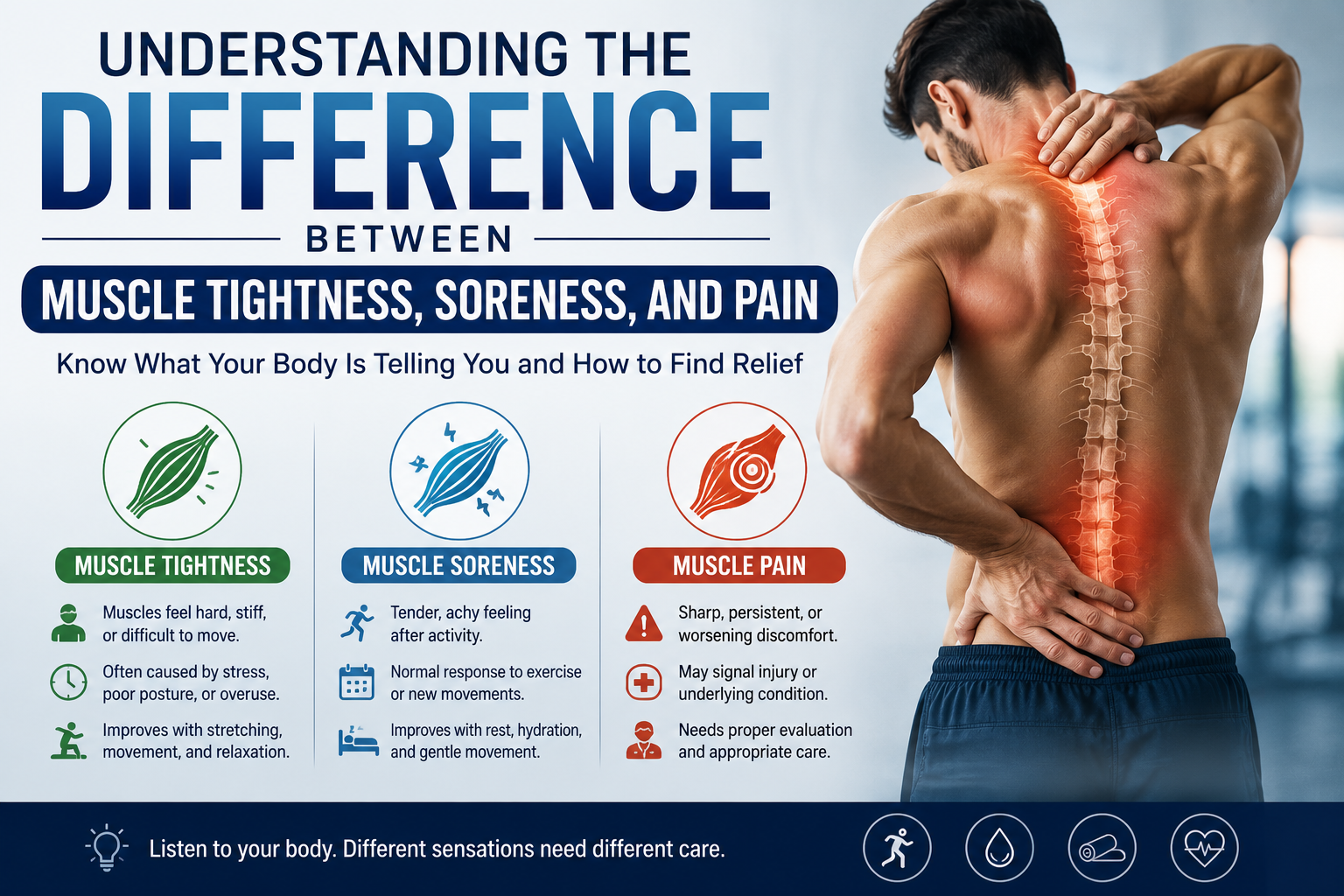
Your muscles can complain in several different ways. Sometimes they feel stiff or restricted. Sometimes they are sore after exercise. Other times, discomfort can feel sharp, burning, throbbing, or persistent.
Because muscle tightness, soreness, and pain can overlap, it isn't always easy to understand what your body is trying to tell you.
Knowing the difference can help you make better decisions about rest, activity, self-care, and when to seek medical advice.
What Is Muscle Tightness?
Muscle tightness generally refers to a sensation that a muscle feels tense, stiff, shortened, or difficult to move comfortably.
You may notice tightness after sitting in one position for a long time, spending hours at a computer, exercising, experiencing stress, or sleeping in an awkward position.
Common sensations include:
A feeling of stiffness
Reduced flexibility
Difficulty moving through your normal range of motion
A constant feeling of tension
Muscles that feel "knotted"
Tightness that improves after gentle movement or stretching
Stress can also contribute to muscle tension. When people are anxious or under prolonged stress, they may unconsciously tense their shoulders, neck, jaw, or back.
What Does Tightness Feel Like?
Imagine your shoulders feeling as though they are constantly raised toward your ears. There may not be a specific painful spot, but you feel as though the muscles cannot completely relax.
That's often closer to tightness than pain.
However, persistent tightness can eventually contribute to discomfort or pain, particularly when it affects posture or movement.
What Is Muscle Soreness?
Muscle soreness is commonly associated with physical activity or unfamiliar exercise.
If you try a new workout, increase the intensity of your routine, or use muscles differently than usual, you may experience delayed-onset muscle soreness, commonly called DOMS.
DOMS typically develops after exercise rather than during it and can become noticeable over the following day or two.
The muscles may feel:
For many people, ordinary post-exercise soreness gradually improves as the body recovers.
What Is Muscle Pain?
Pain is a broader term describing an unpleasant sensory experience. It can arise from muscles, joints, nerves, connective tissues, or other parts of the body.
Muscle pain may be caused by things such as:
Unlike ordinary soreness, pain can sometimes occur without recent exercise.
Its character can also provide clues.
Pain may feel:
Sharp
Burning
Throbbing
Aching
Stabbing
Cramping
Deep or localized
However, the sensation alone cannot always identify the cause.
Muscle Tightness vs. Soreness vs. Pain
A simple way to think about the differences is:
Symptom | Typical Feeling | Common Context |
Tightness | Stiff, tense, restricted | Stress, posture, prolonged sitting, overuse |
Soreness | Achy, tender, sensitive | Exercise or unfamiliar physical activity |
Pain | Sharp, burning, throbbing, aching, or intense | Injury, inflammation, nerve issues, illness, or other causes |
These categories aren't completely separate.
A person can experience tightness and pain at the same time, or soreness accompanied by stiffness.
Why Stress Can Make Muscles Feel Tight
The connection between stress and physical tension is easy to overlook.
When you feel stressed or anxious, your body can enter a heightened state of alertness. Muscle tension is one physical response that can accompany stress.
Some people repeatedly tense their:
Neck
Shoulders
Jaw
Upper back
Lower back
Hands
If this happens for hours every day, you may eventually notice stiffness, headaches, fatigue, or discomfort.
The National Institute of Mental Health lists muscle tension among symptoms associated with generalized anxiety disorder. (nimh.nih.gov)
This doesn't mean every tight muscle is caused by anxiety. Posture, physical activity, injuries, sleep position, and many other factors can contribute.
How Exercise Can Cause Soreness
Exercise creates stress on muscles. When your body is exposed to an activity that is more intense or unfamiliar than usual, the muscles need time to adapt.
This is why you might feel perfectly fine immediately after a workout but become sore later.
Gradually increasing activity and allowing adequate recovery can help reduce excessive soreness.
It's also important to distinguish normal post-exercise soreness from an injury. Severe pain during exercise, significant swelling, major weakness, or pain that doesn't improve should not automatically be dismissed as ordinary soreness.
When Tightness Turns Into Pain
Muscle tightness isn't necessarily dangerous, but persistent tension can become uncomfortable.
For example, spending an entire day hunched over a laptop may leave your neck and shoulders feeling tight. If the same posture and muscle tension continue day after day, discomfort may become more noticeable.
The cycle can look like this:
Poor posture → muscle tension → stiffness → discomfort → reduced movement → more stiffness
Breaking that cycle may involve changing positions regularly, taking movement breaks, improving ergonomics, and addressing contributing stress.
How Can You Tell If Your Muscles Need Rest?
Your body doesn't always give you a simple answer.
Mild soreness after a new activity may simply indicate that your muscles need recovery time. On the other hand, pain that is severe, sudden, or worsening may warrant medical evaluation.
A useful question is:
"Is this discomfort improving with reasonable rest and normal movement, or is it getting worse?"
If symptoms steadily improve, that's generally more reassuring than symptoms that continue to intensify.
Gentle Movement May Be Better Than Complete Inactivity
When muscles are mildly stiff or sore, complete inactivity isn't always necessary.
Gentle walking, normal daily movement, and comfortable range-of-motion exercises may help you avoid becoming even more stiff.
However, you shouldn't push through significant pain simply because you believe discomfort means the body is "working."
Pain is a signal worth respecting.
If an activity clearly makes your symptoms worse, stop and consider discussing the problem with a healthcare professional.
When Should You Be Concerned?
Not every muscle ache requires medical attention, but some symptoms deserve evaluation.
Consider contacting a healthcare professional if muscle pain:
Is severe or unexplained
Follows a significant injury
Keeps getting worse
Doesn't improve as expected
Repeatedly interferes with daily activities
Is accompanied by significant weakness
Occurs with swelling or other concerning symptoms
Appears alongside symptoms affecting other parts of the body
Seek urgent medical attention for severe symptoms such as sudden major weakness, difficulty breathing, chest pain, fainting, or other potentially serious symptoms.
The MedlinePlus muscle aches resource also recommends medical evaluation when muscle aches are severe, persistent, or associated with other concerning symptoms. (medlineplus.gov)
What About Pain Medication?
Some people use over-the-counter pain relievers for occasional muscle discomfort. Depending on the cause and your health history, these medications may not be appropriate for everyone.
For example, certain pain relievers can interact with other medications or may not be suitable for people with particular medical conditions.
Instead of choosing a medication based solely on the location of the discomfort, consider asking a pharmacist or healthcare professional which option is appropriate for your situation.
Medication may reduce discomfort, but it doesn't necessarily address the reason the muscle became tight, sore, or painful in the first place.
The Importance of Looking at the Bigger Picture
Muscle symptoms don't happen in isolation.
Your daily routine can influence how your muscles feel.
Consider:
Sleep: Poor sleep can leave you feeling physically exhausted and may affect how you perceive discomfort.
Stress: Ongoing stress can contribute to muscle tension.
Activity: Sudden increases in exercise can produce soreness.
Posture: Remaining in one position for extended periods can contribute to stiffness.
Recovery: Muscles need adequate time to recover after demanding activity.
Looking at these factors together can be more useful than focusing on a single symptom.
Final Thoughts
Muscle tightness, soreness, and pain may feel similar, but they aren't necessarily the same experience.
Tightness often feels like tension or restricted movement.
Soreness commonly appears after physical activity and feels achy or tender.
Pain is a broader symptom that can have many different causes and may require closer attention, particularly when it is severe, persistent, or accompanied by other symptoms.
Learning to notice these differences doesn't mean diagnosing yourself. Instead, it can help you understand your body's signals and recognize when normal recovery may be enough—and when professional advice is appropriate.
Your muscles don't always speak clearly, but paying attention to when the discomfort started, what it feels like, what makes it better or worse, and whether it is improving can provide valuable information.