For someone struggling with anxiety, the idea of finally feeling calm can be incredibly appealing. A racing mind may slow down, constant worrying may become less intense, and physical symptoms such as tension or trembling may become easier to manage.
But there is an important distinction between reducing anxiety and reducing alertness.
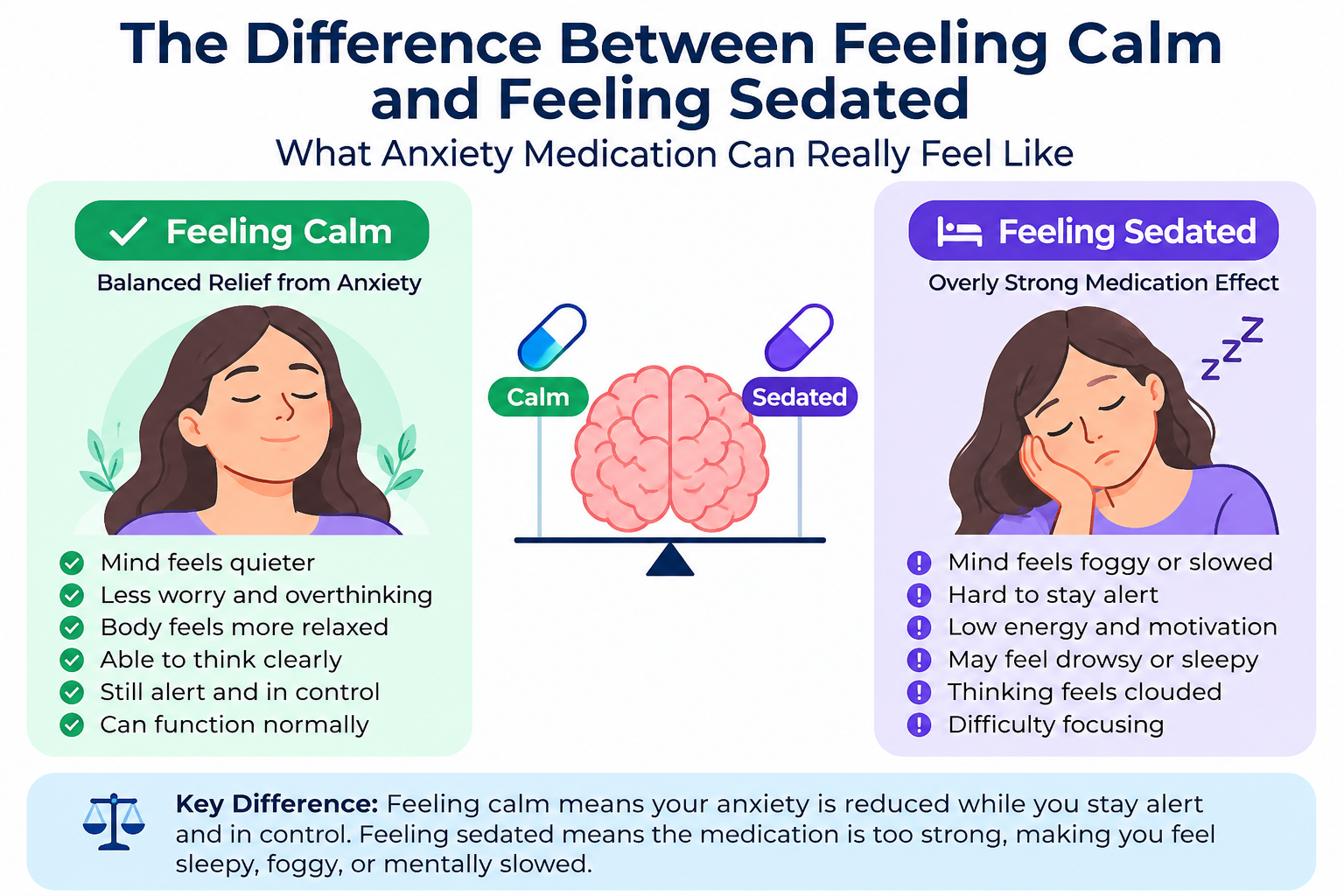
A person may feel calmer while remaining focused, awake, and able to participate normally in everyday activities. Another person may experience sleepiness, dizziness, slowed thinking, or poor coordination.
Both experiences can sometimes be described as “feeling relaxed,” but they aren't necessarily the same.
The National Institute of Mental Health explains that anxiety disorders go beyond ordinary worry and can interfere with everyday life. Depending on the specific disorder and individual circumstances, treatment can include psychotherapy, medication, or both.
Understanding the difference between calmness and sedation can help people communicate more clearly with their healthcare professionals and recognize when medication effects deserve attention.
What Does Feeling Calm Mean?
Feeling calm doesn't necessarily mean feeling sleepy.
A person whose anxiety is improving may still have plenty of energy and awareness. They might notice that:
Worrying thoughts aren't dominating their attention
Everyday situations feel more manageable
They can concentrate more effectively
Physical tension has decreased
They can make decisions more easily
They aren't constantly anticipating something going wrong
They can participate in conversations and normal activities
In other words, anxiety becomes more manageable rather than completely absent.
For example, someone who previously spent hours worrying about an upcoming meeting might still feel some nervousness but can prepare for the meeting, attend it, and continue with the rest of their day.
That can be a meaningful treatment improvement.
What Does Sedation Feel Like?
Sedation is more closely associated with reduced alertness or nervous-system activity.
Depending on the medicine and the individual, sedation can involve:
Sleepiness
Reduced concentration
Slower reactions
Dizziness
Weakness
Mental fog
Reduced coordination
Difficulty staying awake
The FDA notes that benzodiazepines can cause drowsiness and dizziness and carry important risks involving misuse, dependence, and withdrawal.
However, not every anxiety medication is a sedative, and not everyone experiences the same effects.
That's why medication should be evaluated individually rather than based on another person's experience.
Why Can Anxiety Medicines Cause Drowsiness?
Different medicines affect the nervous system in different ways.
Benzodiazepines are one class of medicines used for certain anxiety disorders. They enhance the effects of GABA, an inhibitory neurotransmitter, which can produce calming and sedative effects.
Examples include:
These medicines can be effective for particular anxiety-related conditions, but they aren't appropriate for everyone or every situation.
NIMH notes that benzodiazepines can rapidly reduce anxiety but may lead to tolerance or dependence in some people, which is why healthcare professionals may use them for shorter periods in appropriate circumstances.
The FDA also emphasizes that benzodiazepines should be taken exactly as prescribed and that patients shouldn't abruptly discontinue them after regular use without medical guidance.
Clonazepam (Klonopin): Calmness and Sedation
Clonazepam (Klonopin) belongs to the benzodiazepine class.
Depending on the prescribed indication, it may reduce excessive anxiety or help control certain seizure disorders.
Because benzodiazepines can produce drowsiness, someone taking clonazepam may notice both reduced anxiety and reduced alertness.
That distinction is important.
If a person feels calmer but remains able to think and function normally, the experience is different from feeling so sleepy that ordinary activities become difficult.
The FDA identifies clonazepam among benzodiazepine medicines and warns about risks including misuse, physical dependence, addiction, and withdrawal.
Diazepam (Valium): Why Relaxation Can Feel Different From Sleepiness
Diazepam (Valium) is another benzodiazepine.
It has several medical uses, including certain anxiety-related conditions, muscle spasms, and seizures.
Because of its effects on the central nervous system, some people can experience drowsiness or reduced alertness.
This is why patients should be cautious about activities requiring full attention until they understand how a prescribed medicine affects them.
Importantly, medication should never be adjusted simply because someone wants a stronger calming effect. A healthcare professional should determine whether the treatment and dose remain appropriate.
Lorazepam (Ativan) and Short-Term Anxiety Symptoms
Lorazepam (Ativan) is also a benzodiazepine.
Benzodiazepines can act relatively quickly, making them useful in certain clinical situations. However, rapid symptom relief doesn't mean they are appropriate for unrestricted long-term use.
The FDA's boxed-warning update applies to the entire benzodiazepine class and highlights risks involving misuse, addiction, physical dependence, and withdrawal.
A person taking lorazepam should therefore discuss ongoing treatment with their healthcare professional rather than changing the frequency or amount independently.
Alprazolam (Xanax): Why “Feeling Better” Needs Context
Alprazolam (Xanax) is another benzodiazepine used for certain anxiety and panic-related conditions.
Someone might experience a reduction in intense anxiety after taking it, but that doesn't necessarily mean that becoming increasingly sleepy or impaired represents a better treatment response.
The FDA lists alprazolam among benzodiazepines and specifically warns about combining these medicines with opioids, alcohol, or other central nervous system depressants because of potentially serious consequences.
This is especially relevant when a patient is taking multiple prescription medicines.
What About Tramadol and Methadone?
Tramadol and methadone are opioid medicines rather than anxiety medications.
They may appear in a person's medication list when pain or other specific medical conditions are being treated, but they shouldn't be considered substitutes for anxiety treatment.
The FDA identifies tramadol and methadone among opioid medicines and emphasizes that opioids carry risks including misuse, addiction, overdose, and death.
This becomes particularly important when an opioid is used alongside a benzodiazepine.
The FDA warns that combining benzodiazepines with opioids can increase the risk of severe respiratory depression and death.
Never combine these medicines, alcohol, or other sedating substances unless your healthcare professional has specifically evaluated the combination.
Calmness vs. Sedation: What's the Difference?
Feeling calmer | Feeling sedated |
Anxiety feels more manageable | Sleepiness becomes prominent |
Thinking remains relatively clear | Thinking may feel slowed |
Normal activities remain possible | Activities may become difficult |
Concentration may improve | Concentration may worsen |
Person feels more capable | Person may feel impaired |
Emotional responses remain present | Person may feel unusually slowed down |
This isn't a diagnostic test. Individual reactions vary, and symptoms should be discussed with a healthcare professional.
Why “More Relaxed” Isn't Always Better
It's easy to assume that stronger sedation means stronger anxiety relief.
That's not necessarily true.
The purpose of anxiety treatment isn't simply to make someone as sleepy or relaxed as possible.
A successful treatment should ideally help reduce problematic anxiety while allowing the person to function safely.
For example, if medication makes someone too drowsy to work, drive, study, or participate in normal activities, that is important information for the prescriber.
The answer isn't necessarily to stop the medicine. Instead, the healthcare professional may need to reassess the medication, dose, timing, other medicines, or overall treatment strategy.
Anxiety Treatment Isn't Always About Sedation
There are several approaches to treating anxiety.
NIMH notes that SSRIs and SNRIs are commonly used for conditions such as generalized anxiety disorder and may take several weeks to begin working.
Buspirone is another anti-anxiety medication that isn't a sedative in the same way benzodiazepines are and generally needs to be taken consistently for several weeks to reach its full effect.
Psychotherapy is another major component of anxiety treatment.
Cognitive behavioral therapy (CBT), for example, has been extensively studied for anxiety disorders.
This demonstrates why anxiety treatment isn't simply about finding a medicine that produces the strongest immediate feeling of relaxation.
Why Medication Timing Can Matter
Some medications have relatively short effects, while others remain in the body for much longer.
That means timing can influence how someone feels during different parts of the day.
A person might report:
“I feel fine in the morning but very sleepy in the afternoon.”
Another might say:
“My anxiety is worse before my next scheduled dose.”
These details can help a clinician understand the overall treatment experience.
Patients shouldn't change their schedule independently, particularly with medicines that can cause dependence or withdrawal.
Instead, they should record what they're experiencing and discuss it with their healthcare professional.
The Importance of Medication Interactions
One medication may be tolerated well on its own but become problematic when combined with another substance.
This is particularly important with medicines that affect the central nervous system.
The FDA advises healthcare professionals to consider other medicines a patient is taking when prescribing benzodiazepines and to use particular caution with opioids and other central nervous system depressants.
That includes making your healthcare team aware of:
Prescription medications
OTC medicines
Sleep aids
Supplements
Alcohol
Other substances
Don't assume that something sold without a prescription is automatically safe to combine with your prescribed treatment.
What Should You Tell Your Doctor?
Instead of simply saying “the medication works,” give specific information.
For example:
“My anxiety is better, but I'm extremely sleepy.”
“I feel calmer and can concentrate better.”
“I feel dizzy after taking it.”
“My anxiety is better, but I feel mentally foggy.”
“I haven't noticed improvement yet.”
“I feel more alert since my anxiety improved.”
“I recently started another medication.”
“The symptoms seem to change at a particular time of day.”
These details can help a healthcare professional determine whether the benefits and side effects are acceptable.
Don't Stop Certain Medicines Suddenly
One of the most important safety considerations involves benzodiazepines.
The FDA warns that physical dependence can develop even when benzodiazepines are taken as prescribed. Abrupt discontinuation or reducing the dose too quickly can cause serious withdrawal reactions, including seizures.
Therefore, someone who has been regularly taking a benzodiazepine shouldn't suddenly stop it without discussing a medically appropriate plan with their prescriber.
The same principle applies more broadly: don't change prescription medication doses based solely on information from a blog, social-media post, or another person's experience.
What Does Successful Anxiety Treatment Actually Look Like?
Successful treatment doesn't necessarily mean feeling completely relaxed all the time.
It may look like:
Being able to concentrate again
Spending less time worrying
Returning to activities previously avoided
Sleeping more consistently
Feeling less overwhelmed by ordinary situations
Recovering more quickly after stressful events
Participating in social situations
Feeling capable of making everyday decisions
In other words, successful treatment may be less about “feeling different” and more about being able to live differently.
Final Thoughts
The difference between feeling calm and feeling sedated is an important part of understanding anxiety treatment.
Clonazepam (Klonopin), Diazepam (Valium), Lorazepam (Ativan), and Alprazolam (Xanax) are benzodiazepines that can produce calming and sedative effects, but they also carry important risks involving dependence, misuse, and withdrawal.
Tramadol and Methadone are opioids used for specific medical purposes and are not substitutes for anxiety treatment. Combining opioids with benzodiazepines can create serious safety risks and should only occur under appropriate medical supervision.
Anxiety treatment is highly individual. The goal isn't simply to make someone feel sleepy or completely free of emotion. The goal is to reduce problematic anxiety while supporting alertness, functioning, safety, and quality of life.
If medication makes you unusually sleepy, confused, dizzy, or difficult to wake—or if you experience breathing difficulties—seek medical attention promptly. Never change or discontinue prescription medication without discussing it with a qualified healthcare professional.