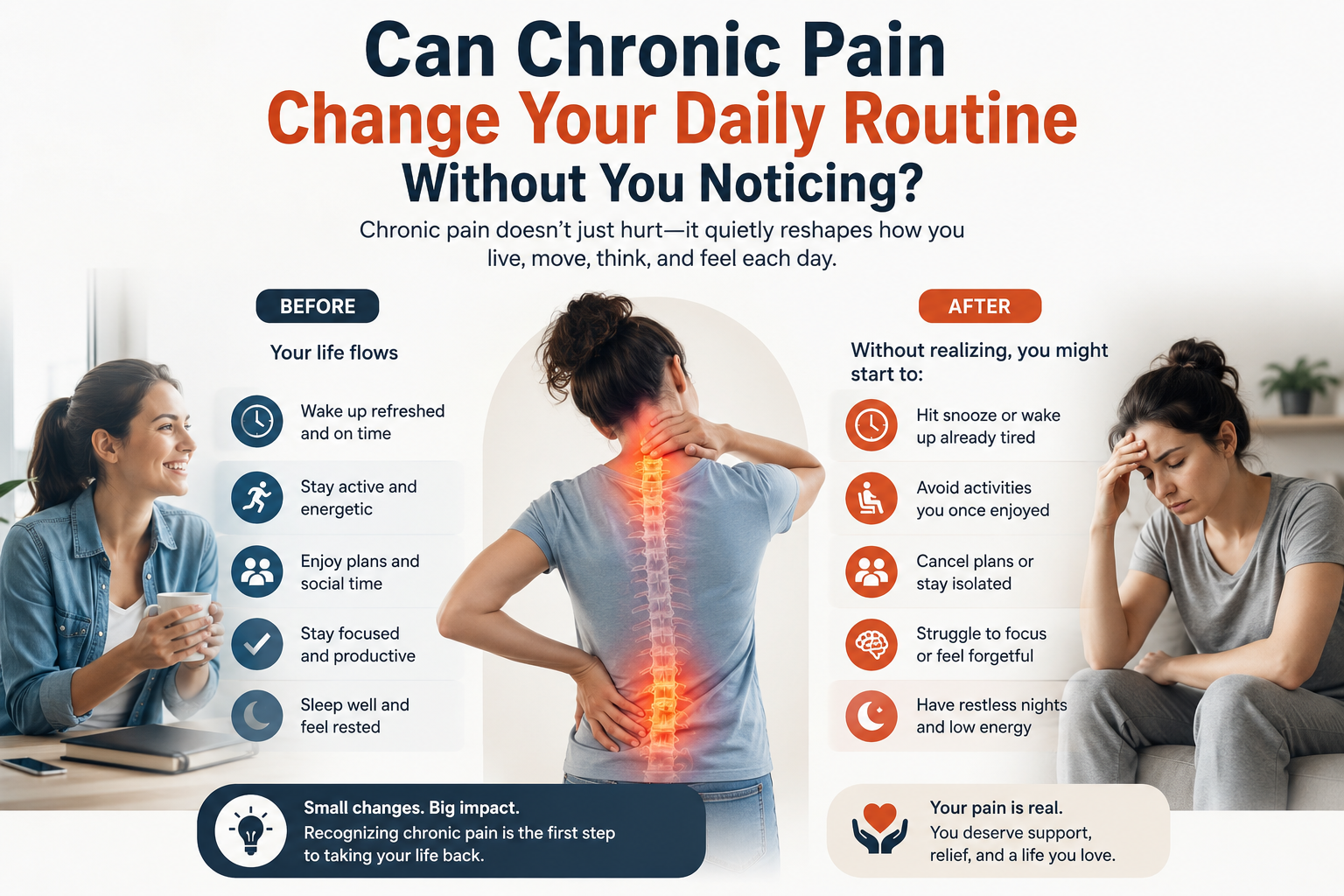
Can Chronic Pain Change Your Daily Routine Without You Noticing?
Chronic pain doesn't always change your life overnight. More often, it happens quietly. You skip one workout because your back hurts. You take the elevator instead of the stairs. You cancel dinner because you're tired. You spend a little longer in bed because getting up feels difficult.
One decision doesn't seem important.
But when those decisions happen repeatedly, chronic pain can gradually reshape your entire daily routine without you even realizing it.
According to the CDC's National Center for Health Statistics, chronic pain is common among U.S. adults and can interfere with everyday activities and quality of life. That makes understanding the lifestyle effects of persistent pain just as important as understanding the pain itself.
When Pain Slowly Becomes Part of Your Routine
Imagine waking up with lower-back pain.
You don't stretch because you're worried it might hurt.
You sit down to get dressed.
You drive instead of walking.
At work, you avoid standing for too long.
After work, you're too tired to exercise.
You order dinner because cooking requires standing.
At night, you struggle to find a comfortable sleeping position.
The following morning, you're tired and sore again.
Nothing dramatic happened. Yet your entire day has gradually become organized around managing or avoiding pain.
This is one of the most overlooked effects of chronic pain.
1. You May Become Less Active
When something hurts, avoiding it feels logical.
If walking makes your knee hurt, you walk less. If bending aggravates your back, you bend less. If exercise causes discomfort, you may stop exercising altogether.
Over time, however, reduced activity can affect strength, flexibility, endurance, and confidence in movement.
The National Institute on Aging explains that physical activity can be beneficial for many people living with chronic conditions, although the type and intensity of activity should be appropriate for the individual's health situation.
That doesn't mean you should push through severe pain.
Instead, the goal is often to find safe, manageable ways of remaining active.
For some people, that might mean:
The important thing is to avoid turning temporary pain-related limitations into permanent inactivity without discussing them with a healthcare professional.
2. Your Social Life May Quietly Shrink
This is one of the changes people often notice only after months or years.
You might start saying:
"Maybe next time."
"I'm too tired today."
"I don't know how my pain will be tomorrow."
"I can't sit that long."
Eventually, invitations may become less frequent.
You may stop going to restaurants, concerts, family gatherings, vacations, or social events because you're worried about how your body will respond.
The problem is that chronic pain isn't only physical. It can also affect emotional well-being.
The National Center for Complementary and Integrative Health (NCCIH) notes that chronic pain can be associated with sleep problems, anxiety, depression, and reduced quality of life.
So pain can create a frustrating cycle:
Pain → isolation → low mood → less activity → poorer coping → pain becomes harder to manage.
3. Your Sleep May Start Revolving Around Pain
For many people with chronic pain, bedtime doesn't necessarily mean relaxation.
Instead, bedtime becomes a search for the least painful position.
You change pillows.
You turn over.
You adjust your legs.
You sit up.
You try another position.
Eventually, you fall asleep—but wake up several times during the night.
Poor sleep can then make the next day harder.
You're tired.
You're less active.
You're more irritable.
Your concentration suffers.
And coping with pain becomes more difficult.
The National Institutes of Health discusses the relationship between pain, sleep, mood, and activity and emphasizes that managing chronic pain often requires more than simply treating the pain sensation itself.
This is why improving sleep can be an important part of a broader pain-management plan.
4. You May Start Avoiding Certain Movements
Have you ever caught yourself thinking:
"I can't move that way because it will hurt."
Maybe you avoid bending.
Maybe you don't lift objects.
Maybe you always turn your entire body instead of turning your neck.
Maybe you use one side of your body more than the other.
These adaptations can sometimes be useful during an injury or flare-up.
But if they continue indefinitely, your world can become smaller.
You may stop doing things you previously enjoyed—not because you physically cannot do them, but because you're afraid of triggering pain.
That fear can become part of the pain experience itself.
The National Institute of Neurological Disorders and Stroke explains that pain involves complex interactions between the nervous system, body, and emotional factors.
Understanding this doesn't mean pain is imaginary.
It means pain is more complicated than a simple signal from an injured body part.
5. Work Can Become More Difficult
Chronic pain can affect the way you work even when you remain employed.
You might:
Take more breaks
Avoid certain responsibilities
Work more slowly
Change your workstation
Alternate between sitting and standing
Reduce overtime
Take more sick days
Avoid physically demanding tasks
Sometimes these adjustments are exactly what you need.
But if your productivity or ability to work has changed significantly because of pain, it's worth discussing the situation with a healthcare professional.
Physical therapy, workplace modifications, appropriate exercise, and treatment of the underlying condition may help some people function more comfortably.
6. You May Stop Doing Things You Enjoy
This can be one of the most emotionally difficult consequences.
Maybe you used to:
Play sports
Garden
Travel
Cook
Dance
Go hiking
Play with your children
Meet friends
Work on hobbies
Now you might spend most of your free time sitting or lying down because it's easier.
Eventually, you may realize:
"My life has become smaller."
That's an important observation.
The goal of pain management shouldn't simply be "make the pain disappear."
For many people, a more realistic goal is:
"Help me participate in my life again."
7. Chronic Pain Can Affect Your Mood
Living with pain every day can be exhausting.
Imagine having to think about your body before doing ordinary things.
Will this chair hurt?
Can I walk that far?
Will I sleep tonight?
Will tomorrow be a bad pain day?
That constant mental calculation can become emotionally draining.
According to the NCCIH, chronic pain and mental-health difficulties can interact with one another.
Pain can contribute to stress and low mood, while emotional distress can influence how a person experiences and copes with pain.
This is why addressing the emotional side of chronic pain isn't admitting that the pain is "all in your head."
It's treating the whole person.
The "New Normal" Can Be Hard to Notice
Perhaps the biggest problem is that these changes happen gradually.
You don't wake up one morning and decide:
"I'm going to completely change my lifestyle because of pain."
Instead:
Monday: You skip the gym.
Next week: You stop taking long walks.
Next month: You cancel a trip.
Six months later: You rarely leave the house.
And suddenly, your old routine feels unfamiliar.
That's why occasionally asking yourself a simple question can be useful:
"What am I no longer doing because of my pain?"
The answer can reveal just how much chronic pain has influenced your life.
How Can You Start Taking Back Your Routine?
You don't have to completely rebuild your life overnight.
In fact, trying to do everything at once may leave you frustrated.
Instead, start small.
Choose one activity that matters to you
Maybe it's walking.
Maybe it's cooking.
Maybe it's seeing friends.
Maybe it's playing with your children.
Maybe it's returning to a hobby.
Then discuss with your healthcare professional how that activity could potentially be modified to fit your current abilities.
Try Pacing Instead of Overdoing It
One common mistake is having a relatively good day and trying to accomplish everything you've been unable to do.
You feel good, so you clean the house, exercise, run errands, meet friends, and stay up late.
Then the next day you're in significant pain.
This pattern is sometimes called boom-and-bust activity.
Instead, pacing means distributing activities more evenly and increasing activity gradually.
The National Institute on Aging recommends gradually building physical activity and avoiding overexertion.
Keep a Pain and Activity Journal
You don't need a complicated system.
For a week, record:
Morning: How do I feel?
Activity: What did I do?
Pain: How intense was it?
Sleep: How well did I sleep?
Mood: How was my emotional state?
Evening: Did anything make symptoms better or worse?
You may discover patterns you hadn't noticed before.
For example, perhaps your pain isn't necessarily worse because you walked—it may be worse because you walked for an hour after sitting for eight hours.
That distinction can be valuable.
What About Medication?
Medication may be appropriate for some types of chronic pain, but there is no universal pain medication that works for everyone.
Depending on the underlying cause, healthcare professionals may consider different medications and treatment strategies.
Some people may be prescribed non-opioid pain relievers or anti-inflammatory medications, while certain forms of nerve-related pain may be treated with medicines that affect nerve signaling.
Some antidepressant or anticonvulsant medicines may also be used for particular chronic-pain conditions, even when depression or epilepsy isn't the reason they're prescribed.
The National Institutes of Health explains that chronic-pain treatment can involve a combination of approaches rather than relying on medication alone.
If you're taking prescription medication, don't change the dose, combine medicines, or suddenly stop treatment without discussing it with your healthcare professional.
The right treatment depends on the type of pain, underlying condition, other medications, medical history, and individual risks.
Physical Therapy Can Be Part of the Solution
Physical therapy isn't simply about exercising through pain.
A physical therapist can assess movement patterns, strength, flexibility, balance, and functional limitations and then develop an individualized plan.
The National Institute on Aging provides information on seeking professional help for persistent pain and discusses approaches that can help people maintain function.
For some people, the goal isn't to eliminate every sensation of pain.
It's to become stronger, more confident, and more capable of performing meaningful activities.
Don't Forget the Psychological Side
If chronic pain has made you anxious, isolated, frustrated, or depressed, addressing those issues is not separate from pain management.
It's part of it.
Psychological approaches such as cognitive behavioral therapy and certain mind-body techniques may help some people cope with chronic pain and improve quality of life. The NCCIH provides an overview of evidence surrounding mind-and-body approaches for chronic pain.
Getting psychological support doesn't mean your pain isn't physical.
It means you're recognizing that living with persistent pain affects the entire person.
When Should You See a Doctor?
Persistent pain that interferes with your sleep, work, movement, relationships, or everyday activities deserves medical attention.
You should seek prompt medical evaluation for severe or rapidly worsening pain, significant weakness or numbness, pain after major trauma, loss of bladder or bowel control, fever associated with severe pain, unexplained weight loss, or other concerning symptoms.
And if chronic pain has contributed to severe hopelessness, depression, or thoughts of self-harm, seek urgent professional support.
Final Thoughts: Don't Let Pain Quietly Write Your Schedule
Chronic pain can change your routine in ways that aren't obvious at first.
You stop exercising.
Then you stop going out.
You sleep differently.
You work differently.
You move differently.
You stop doing things you love.
Eventually, you may realize that you're no longer planning your day around what you want to do.
You're planning it around what you think your pain will allow you to do.
That realization doesn't mean you've failed.
It gives you something important to work with.
With appropriate medical care, physical activity adapted to your abilities, better sleep, psychological support when needed, and a personalized treatment plan, many people can work toward regaining function and improving quality of life.
You don't necessarily have to get your old life back all at once. Start by getting one small piece of it back.